BETA
02.10.2026
Attention
Landslide conditions over the past days and the coming weekend
- More rainfall is increasing the likelihood of rockfalls and landslides this weekend.
- Several landslides have occurred in the East Fjords in recent days (see the landslide registry).
- Notable landslide activity has been observed in Gleiðarhjalli above Ísafjörður.
Since September 24th, Iceland has been affected by a series of low-pressure systems. Heavy precipitation has been recorded in the West Fjords, East Fjords, Southeast Iceland, South Iceland, and the Central Highlands. As a result, runoff, erosion, and landslide activity have increased.
Over the past three days, significant rainfall affected the East Fjords, Southeast Iceland, South Iceland, and the Central Highlands. High runoff in river systems caused bank erosion, adding sediment to rivers and streams, many of which have turned brown as a result. In some locations, erosion caused disruptions to transportation, including in the East Fjords and Þórsmörk. Several small landslides have also been recorded in the East Fjords without causing damage or affecting traffic.
Current measurements indicate high groundwater levels in monitoring boreholes at Seyðisfjörður and Eskifjörður, as well as high river discharge across the Eastfjords, the Southeast, the South and the Central Highlands. This suggests that the pore-water pressure in slopes throughout these areas is generally elevated.
Another low-pressure system is forecast to move across Iceland on Saturday, October 3rd. The total precipitation associated with this system is not expected to be significant in terms of landslide hazard. However, as the ground is already saturated across many parts of the country, even a small amount of additional rainfall may be sufficient to trigger slope movements and landslides. The Landslide watch is closely monitoring the situation throughout the weekend.
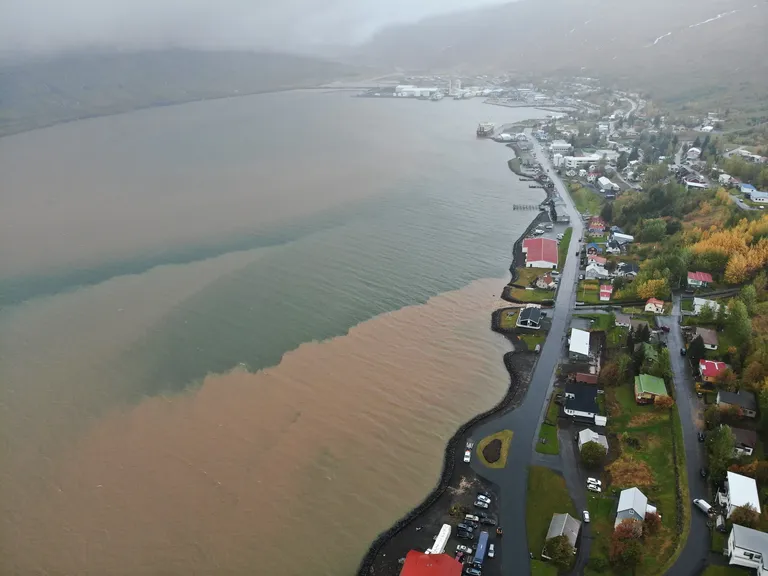
Debris from Ljósá in Eskifjörður.
On Thursday, 2 October, interesting landslide activity was observed in Gleiðarhjalli above Ísafjörður. At 14:27, a landslide occurred at the edge of the bench, involving both soil and snow. The failure triggered rockfall that descended the slope and a smaller landslide that travelled approximately halfway down the hillside. At 15:30, a debris slide originated from the edge of the bench about 200 metres to the southwest and reached all the way down to the avalanche protection dam. Shortly before midnight, additional rockfalls were recorded in the area.
It is noteworthy that the accumulated precipitation in Ísafjörður has not been particularly high since September 26th, when a low-pressure system brought significant rainfall at lower elevations and snowfall in the mountains. However, temperatures exceeded 10°C on 2 October, and a brief but intense rainfall event was recorded around 08:00 that morning.
The sediment deposits above the bench were covered by snow and were most likely already water-saturated following the precipitation that occurred last weekend. Additional water from rainfall and snowmelt during the morning of 2 October appears to have pushed the slope system beyond its stability threshold, resulting in the landslides described above. This suggests that pore-water pressures within the slope remain elevated and that further water input could readily trigger similar events over the coming weekend.
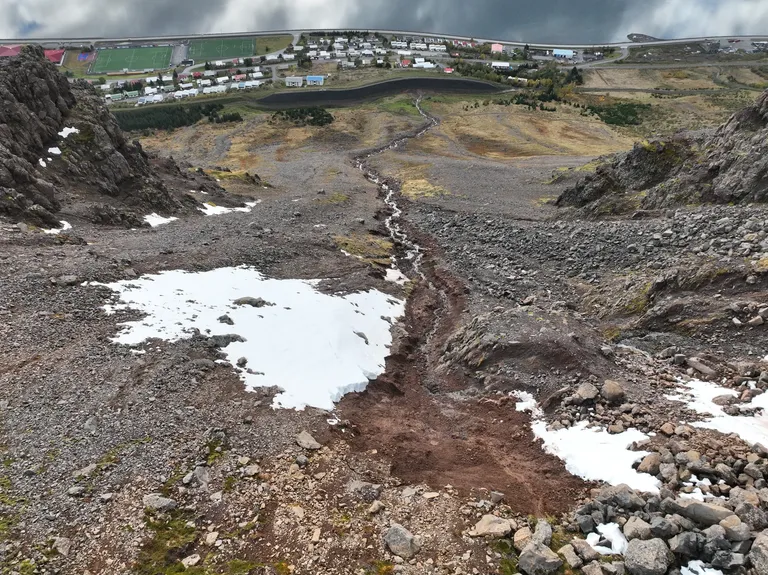
Debris flow from Gleiðarhjalli, Ísafjörður.
The public is encouraged to report landslides and rockfalls to the Landslide Watch. Reports can be sent by email to skriduvakt@vedur.is or submitted using the electronic reporting form for landslides and avalanches. Please provide the precise location and, if known, the time when the landslide or rockfall occurred. If the exact time is not known, it is sufficient to state when it was first observed. Please include photographs where possible. The Landslide Watch reviews the reports and attempts to verify them before they are entered into the Icelandic Meteorological Office’s landslide database.